
The "Awakening" of the Physical World

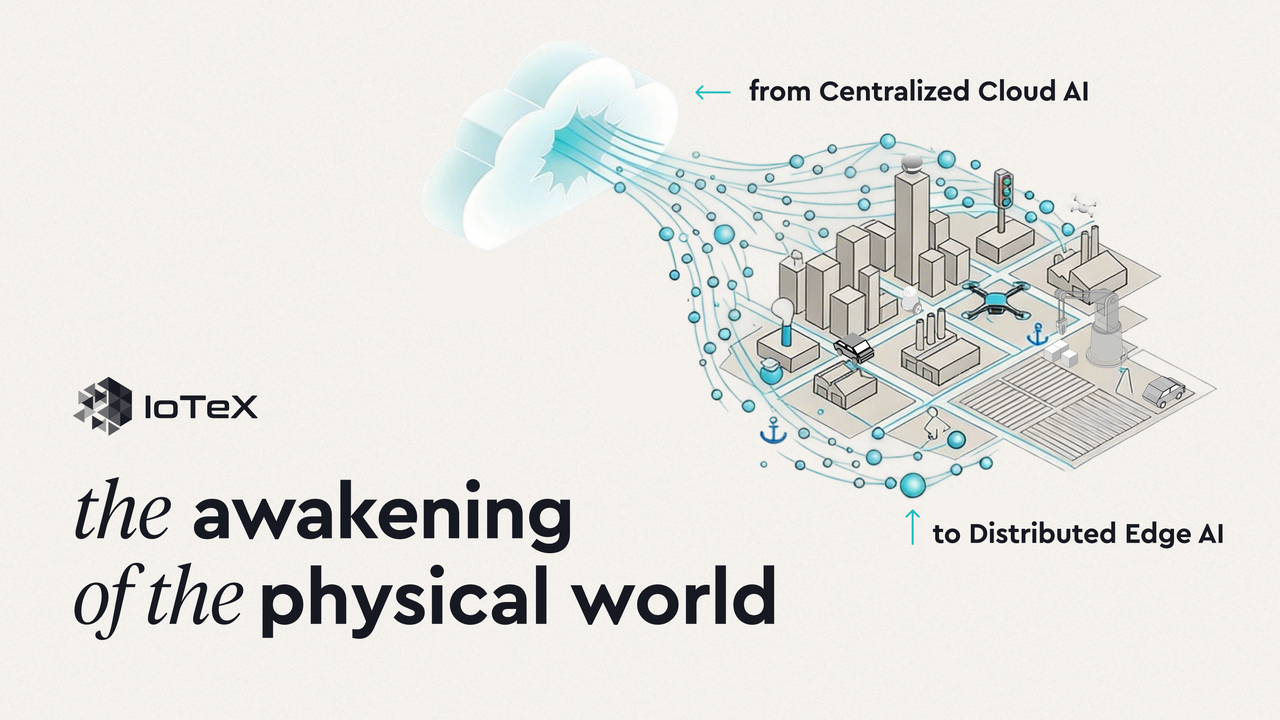
The evolution of Artificial Intelligence is now undergoing a structural shift from cloud-based to on-device intelligence. While the past few years have been defined by the advent of general-purpose Large Language Models (LLMs), the future will be defined by Edge AI models that are industry-specific or even task-specific. These Edge AI models will run locally on smart devices, machines, and other forms of physical infrastructure, introducing a new paradigm for how intelligence is applied to real-world use cases. This transformation is more than just a hardware upgrade; it is a fundamental reimagining of how AI-enabled smart devices can unlock new value for individuals, businesses, and society. In this blog, we share four key themes that will catalyze Edge AI in 2026, and how IoTeX will serve as the foundational infrastructure to drive the Real-World AI revolution.
The Era of Small Language Models (SLM): Task-Specific and Efficient
In 2026, the industry will shift away from massive general-purpose LLMs to Small Language Models (SLMs) that are optimized for specific tasks, workflows, and industries. These SLMs can be fine-tuned to solve specific challenges more effectively and efficiently than LLMs. Whether in real-time quality control on factory floors or intelligent kiosks in retail, SLMs deliver high precision with minimal energy and compute consumption. With smaller parameter counts, SLMs can be deployed directly on edge infrastructure instead of Cloud-based servers. This localized deployment ensures that devices no longer rely on unstable network connections—intelligence remains "online" even when devices are offline.
Distributed Architecture: Compute Follows Data
With 75% of enterprise data now generated outside traditional data centers, the "gravity" of data has shifted -- compute is now being deployed closer to the physical environments where data originates. In 2026, monolithic data centers are being complemented by distributed edge infrastructure. These compact, specialized computing units are deployed near the data source, drastically reducing latency. More importantly, this model solves the sensitive issue of data privacy, enabling sensitive data to be processed locally without being sent to black boxes hosted in Cloud environments. This eco-friendly, high-efficiency architecture is the new bedrock of smart infrastructure for the real world.
Computer Vision: Giving Hardware "Eyes and Ears"
Computer vision is one of the the most promising frontiers for Real-World AI. In 2026, vision models that provide "eyes and ears" for AI agents are now transitioning from prototypes to production. By combining lightweight algorithms with dedicated accelerators, smart cameras that are powered by Edge AI will not only be able to generate motion-detection alerts but actually understand the people, objects, and events in their video feeds. From optimizing traffic flows to monitoring hospital patients to enforcing safety guidelines in warehouses, Edge AI will allow cameras and other sensors to generate unprecedented intelligence and manage dynamic environments.
Embodied Intelligence: Real-World AI Steps into the Physical Realm
Another transformative trend for Real-World AI in 2026 is the seamless integration of AI agents into physical systems and workflows. This means AI will no longer be confined to screens and the digital world. AI agents that are embedded into physical chips and devices will be able to make decisions without humans-in-the-loop and trigger informed actions in the physical world. Instead of only moving bits, AI will now be able to move atoms. With the benefits of Edge AI, such as ultra-low latency and real-time intelligence sourced directly from its surrounding environment, embodied AI agents will play a pivotal role in the future of autonomous systems.
The Foundation of Trust: IoTeX’s Role in Verifying and Democratizing Real-World AI
As AI transitions from Cloud to Edge, trust and verification are more important than ever. Although the promise of embodied AI agents taking actions in the real world will unlock incredible use cases, it also introduces new attack vectors that have serious consequences if not properly addressed. This is where IoTeX plays a pivotal role. In this new era of embodied intelligence, IoTeX provides the verifiable foundation that Real-World AI requires. Through ioID, every device and every embodied AI agent, whether a humanoid robot or an industrial sensor, will be anchored to a tamper-proof identity for provenance and blockchain wallet for agentic commerce. By verifying devices and data at the edge, the IoTeX blockchain ensures Real-World AI is based on reality, not manipulated inputs.
Beyond verification, IoTeX is democratizing access to the Real-World AI economy. IoTeX is on a mission to break down the monopoly of centralized tech giants and allow individuals and businesses to own, operate, and monetize their own localized hardware and Edge AI models. In 2026, the success of AI is no longer just about intelligence; it is about transparency and sovereignty. By bridging the gap between hardware and the blockchain, IoTeX ensures that the "nervous system" of our physical world remains open, verifiable, and owned by the community it serves.