
Post-Quantum, Post-AI, and a Lot More: Six Months of IoTeX


It’s been a while since our last letter. We’ve been heads-down building, so here is everything from the past six months in one place.
Why five doors?
AI is starting to act on its own: agents that write code, buy services and make decisions, and machines that watch, move and react in the physical world. They need infrastructure of their own, and no single company should own it. That’s what IoTeX is building, one door at a time:
- 🛡️ IoTeX L1 is the trust layer: decentralized, and secure even after quantum computers and AI change the math.
- 🐆 Rapid-MLX is the local brain: AI that runs on the Mac you already own.
- ⚡ QuickSilver is the nervous system: one connection to every model, built for agents.
- 👁️ Trio is the eyes: AI that sees the physical world and decides in real time.
- 📱 ioPay is the wallet you carry in your pocket.
Every door leads to the same place: an open, verifiable network for intelligence.
Short on time? Holding IOTX: start with Door 1 and Door 5. Building with AI or agents: Doors 2, 3 and 4 are for you.
Door 1 · IoTeX L1: post-quantum, post-AI, and fully decentralized
Mainnet has been live since April 2019, with more than 54 million blocks produced. This year it took two big steps: taking the middleman out of staking, and getting ready for the day today’s cryptography breaks.
Getting ready for Q-day
Almost every blockchain, IoTeX included, signs transactions with the same kind of cryptography. A large enough quantum computer, or a mathematical shortcut found with AI, could one day break it. We’d rather prepare years early than days late, so two proposals are now up for public review.
IIP-65 “Bunker Mode” gives staked IOTX a second lock. You attach a hash-based key to your staking bucket once; from then on, moving it needs that key too. If the day comes when the old key can be broken, an attacker holding it hits a wall. Draft 4 now ships with a full reference implementation in iotex-core.
IIP-64 goes further and proposes moving IoTeX’s signatures to NIST-standardized post-quantum cryptography (ML-DSA), protected by two independent kinds of math, so one break is not enough.
Both are proposals, not done deals: they’ll go through review, revisions and a governance vote. IIP-64 → · IIP-65 →. Cryptographers welcome.
Meanwhile, we hardened the chain we run today: a series of security releases this summer, and an expanded security policy that invites researchers to report issues privately through GitHub.
Taking the middleman out: staking rewards, 100% on-chain
Voter rewards used to run through an off-chain service that held keys, computed payouts outside consensus and charged a fee. In August, IOTX stakers voted on IIP-59 to move all of it into the protocol, and the Zanzibar hard fork made it real on October 19 at block 53,533,081. No service fee, no trusted operator: the protocol itself now computes and pays your rewards.
$IOTX is coming home
IOTX started life in 2018 as an ERC-20 token on Ethereum, before IoTeX mainnet existed. Since October 12, anyone holding the legacy ERC-20 can redeem it for native IOTX at hub.iotex.io/redeem: 1:1, no fees, same address. Native IOTX pays for gas, secures the network through staking and is supported on Binance, Kraken, Crypto.com, Upbit, Bithumb, Revolut and Bitkub. One tip: send from your own wallet, not straight from an exchange.
Also on L1
In June, the Yap hard fork brought Ethereum’s Pectra upgrade to IoTeX: with EIP-7702, an ordinary wallet can act as a smart account, and new BLS precompiles open the door to modern cross-chain cryptography. Release notes →
Door 2 · Rapid-MLX: run intelligence locally
Rapid-MLX runs AI models on the Mac you already own: private, offline and free. One command, and Claude Code, Codex or OpenCode can work against a model on your own machine instead of a paid cloud API.
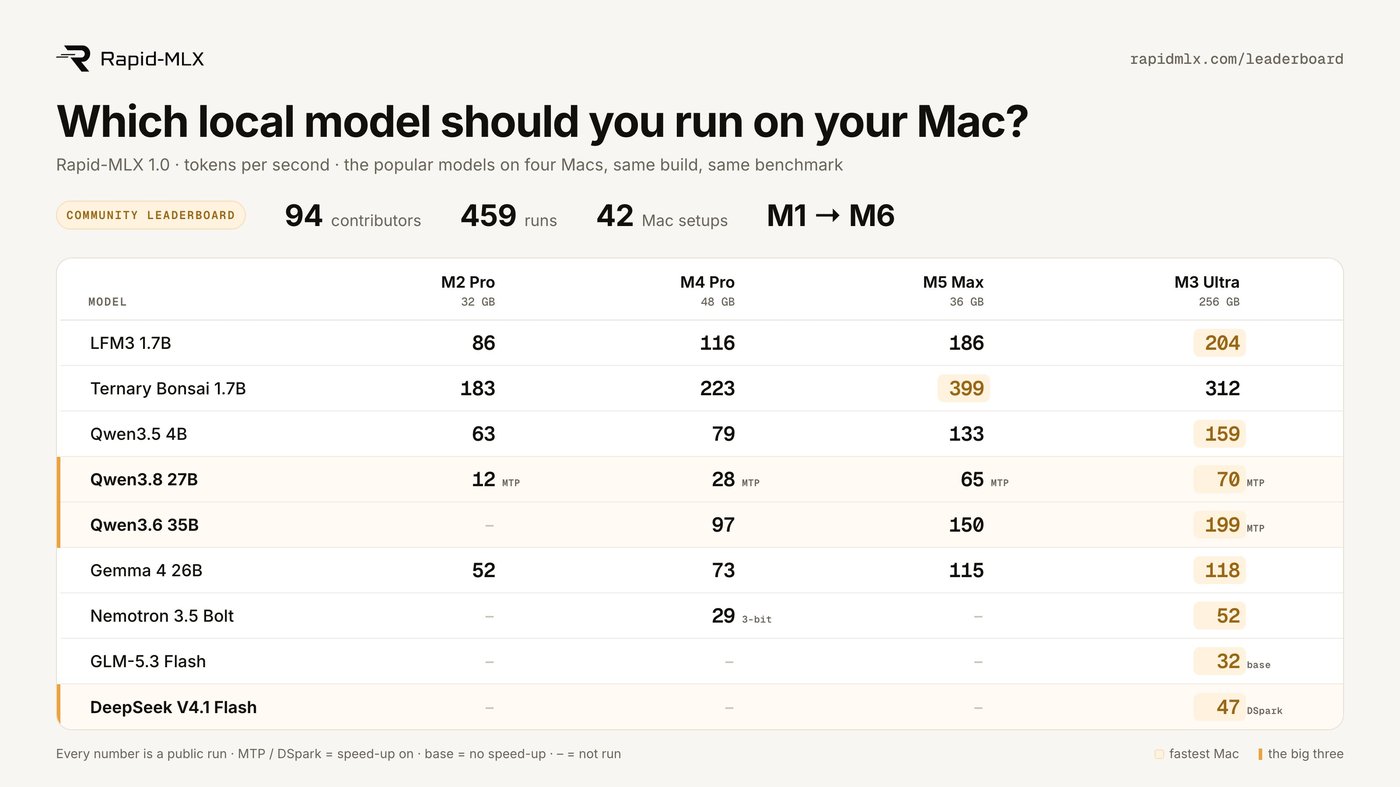
Rapid-MLX 1.0 shipped on October 29, and the community showed up:
- ⭐ 4,100+ GitHub stars, 3,600+ of them since May, from 49 contributors
- 📦 400K+ downloads of its models on Hugging Face, and 100K+ installs from PyPI
- 🏁 731 community benchmark runs from 125 people, on Macs from M1 to M5 Ultra
On the same Mac and model, Rapid-MLX decoded 82.9 tokens/s, against 48.8 for llama.cpp and 27.2 for Ollama. We published the raw data so anyone can check.
Then it learned to make films. Rapid-MLX now generates video with synchronized sound, entirely on a Mac. No cloud, no upload, no queue. This 57-second animated short was made that way:
It also listens and speaks now: transcribe a meeting without it ever leaving your laptop. New open models from Qwen, DeepSeek, NVIDIA, Google and others usually run on Rapid-MLX within hours of release, and you can paste any Hugging Face link to check whether it fits your Mac before downloading a byte.
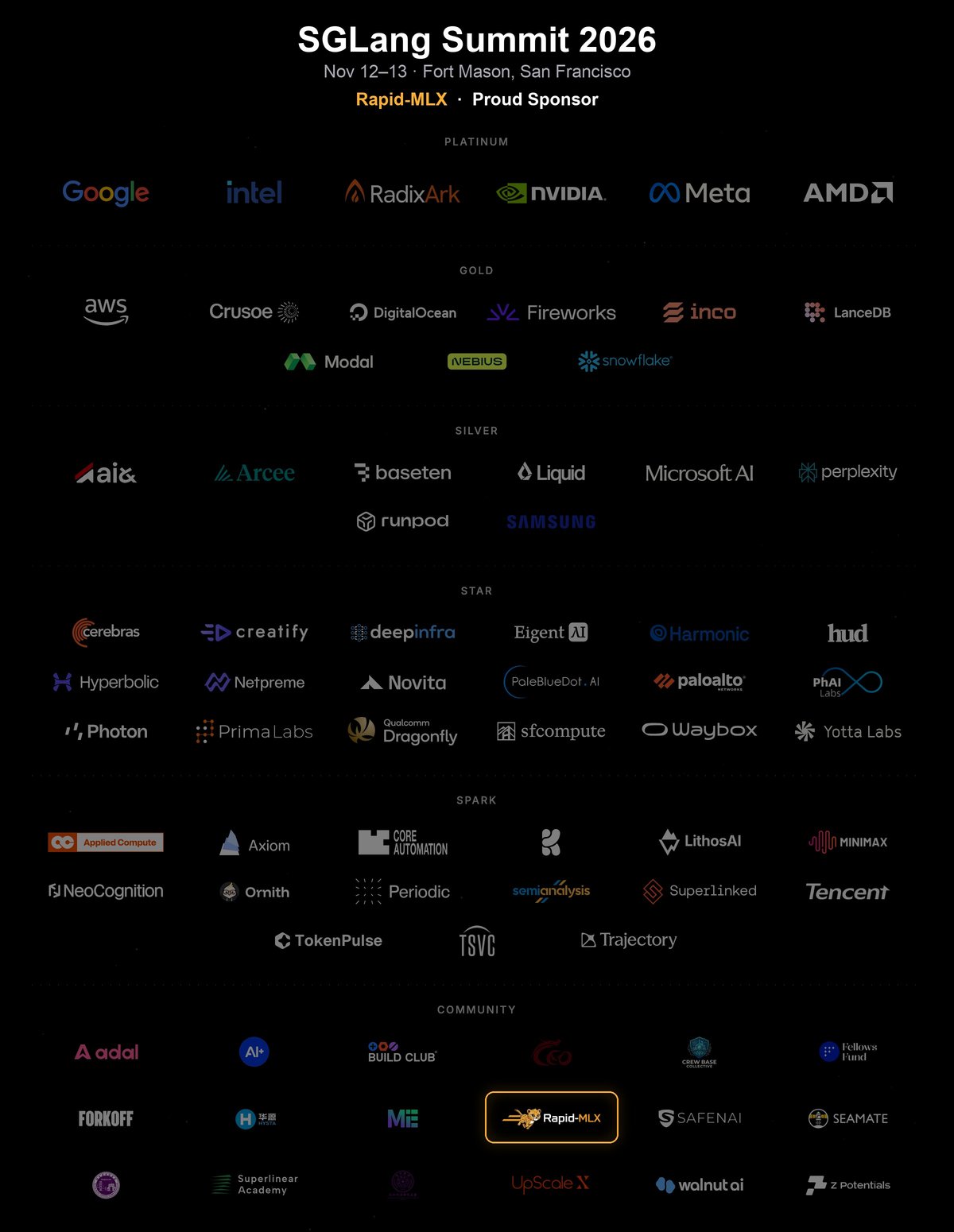
This week, Rapid-MLX is a sponsor of SGLang Summit in San Francisco (Nov 12–13), on the same sponsor wall as Google, NVIDIA, Meta, AMD and Intel.
Door 3 · QuickSilver: connect intelligence
Tired of putting a credit card behind every AI agent? With QuickSilver, an agent can pay for itself: through x402, it sends USDC and gets an API key back in a single request, with no account and no card.
That key opens every frontier and open model through one API: Claude, GPT, Gemini, DeepSeek, Qwen, Kimi and 90+ more, OpenAI- and Anthropic-compatible, at prices well below list. New flagship models, like Claude Fable 5.2 and Qwen4-Max this week, usually go live the same day they launch.
The growth has been steep:
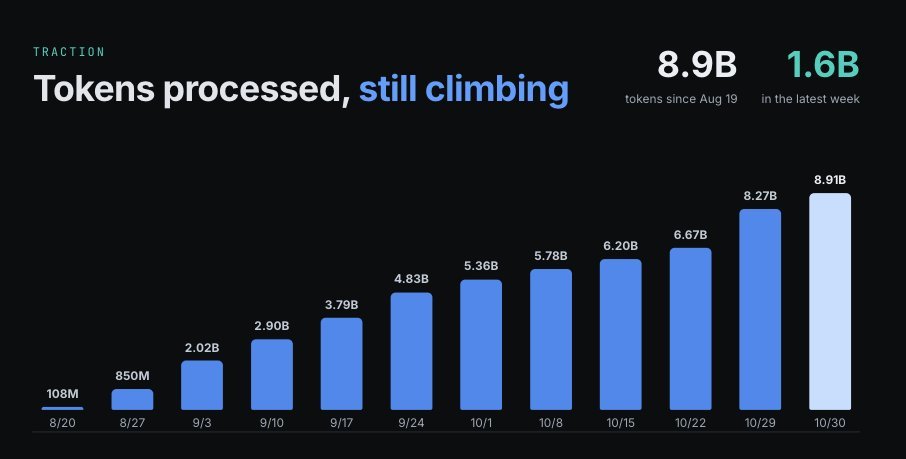
- ⚡ 9.3 billion tokens served since August, across 412,000+ API calls
- 📈 +31% month over month, with 3.3 billion tokens in the last 30 days alone
- 👥 1,000+ users building on it
And now, a computer for your coding agent. QuickSilver Machines, launched November 3, are cloud dev boxes with Claude Code, Codex, OpenCode and Hermes preinstalled. Click once, and in about 30 seconds your agent has a Linux desktop of its own, for $0.02 an hour.
QuickSilver is trusted by Samsung Next, Jump Trading, Goodwater Capital and Xoogler Ventures, with American Cloud as our infrastructure partner.
Door 4 · Trio: see and decide in real time
Trio, built by MachineFi Lab and the IoTeX core team, is our answer to a simple question: how does AI start operating the physical world, not just describing it?
In June, Trio learned to see. We introduced Trio as a world model for physical operations. Its open-source perception layer, Trio-Retina, turns ordinary cameras into live scene understanding, and Trio-Lumen lets you tell a camera, in plain English, what to watch for.
This fall, Trio learned to decide. Trio-Spark is a fast-decision model: give it a situation and a few possible actions, and it picks one, with a calibrated probability for every option, in a single step. Because it doesn’t write out an answer word by word, it’s fast and extremely cheap. Version 1.4, released October 28, handles text, photos and video through one API, and its research build, Trio-Spark DI (9B), broke into the top 10 among models of 9B parameters or less on Hugging Face’s Decision Index.
What that looks like in practice, from our own tests:
- 🚚 Told what US trucks were hauling from random photos, with no training: 83% accuracy, every hazmat placard caught, at $14 per million photos
- 🎫 Routed 1,000 support tickets for half a cent, matching human routing 94.7% of the time
- 🚁 Flew a drone through a 75-meter obstacle course: 25 decisions, zero collisions
Door 5 · ioPay: carry intelligence in your pocket
ioPay, our self-custody wallet, kept expanding what you can reach from your phone: Robinhood Chain for tokenized stocks and real-world assets (July), Arc for stablecoin-native payments (September), prediction markets with clearer price charts, a redesigned DApp Hub, built-in network proxy settings, and a security upgrade in ioPay 6.0.

On the road
We spent this year where builders are: on stage at Consensus 2026 in Miami, at SF Tech Week in October, and this week at SGLang Summit in San Francisco. If you’re building with local AI, agents or intelligent machines, we’d love to meet.

Start building today
More to explore:
- Holding legacy ERC-20 IOTX? Redeem it 1:1.
- Building something that sees? Try Trio-Spark.
- Into cryptography? Review IIP-64 and IIP-65.
Thanks for sticking with us. Follow @iotex_io for the day-to-day, and we’ll be back in your inbox soon.
The IoTeX Team