
IoTeX’s Anti-Roadmap for 2026

Every year, crypto projects publish roadmaps. Neat timelines. Color-coded phases. Quarterly milestones with checkmarks that nobody checks. We've done it too.
We're not doing it this year.
Not because we don't have a plan. We do. But because the honest thing to say is: we don't know what the world looks like in twelve months, and neither does anyone else.
AI is compressing decades of change into quarters. Models that didn't exist in January are obsolete by June. Entire product categories appear, get commoditized, and get replaced — in weeks. The rate of change itself is accelerating, and any roadmap precise enough to look credible is precise enough to be wrong.
So instead of pretending to be prophets, we're going to do something different. We're going to tell you the three challenges we need to address — and our current best thinking on how to approach them. Not a map, but a compass. Not predictions, but directions of search.
Challenge 1: How does IoTeX become AI's interface to the physical world — and make money doing it?
This is the existential challenge.
In 2025, we laid important groundwork. Quicksilver gave AI agents a way to request and verify live machine data — at peak, over 3,000 daily AI agent queries. ioID crossed the path toward a million device identities. We demonstrated machine-to-machine payments with Coinbase's x402 protocol. We proved the concept: AI agents can interact with physical-world infrastructure through a blockchain protocol.
But proving a concept isn't proving a business. And in 2026, the question has shifted from "can we connect AI to physical devices" to something far more urgent: Who pays for this, and why? The obvious answer is humans. But humans won’t be the only customers. The physical internet has many users. Construction sites that need continuous monitoring. Retail chains that need real-time analytics. Factories that must enforce safety compliance. But the next customers won’t be people at all. They will be machines. AI agents optimizing logistics networks. Delivery systems routing fleets in real time. Autonomous operations managing warehouses, ports, and supply chains. Robotics will become constant consumers of physical intelligence. Warehouse robots navigating crowded environments. Traffic systems coordinating intersections. Drones monitoring infrastructure, agriculture, and energy grids. All of them need the same primitive. Perception. Verification. Automation. They need to see the world. They need to trust what they see. They need to act on it. That is what they will pay for. The customers of the physical internet are not only humans. They are machines. And the machine economy is just beginning.
AI is blind to the physical world. That's the opportunity. AI can read every webpage, parse every database, analyze every financial filing. The digital world is transparent to it. But ask a simple physical-world question — Is it raining in Shoreditch right now? How crowded is this intersection at 5pm? — and it's helpless. No eyes, no ears, no real-time perception.
This matters because AI agents are moving from answering questions to taking actions — booking, buying, routing, managing. An AI that can't perceive the physical world can only operate in half of reality. Our goal: make IoTeX the protocol through which AI sees, verifies, and acts on the physical world.
Vision first. We're starting with cameras. Over a billion deployed globally, hundreds of thousands streaming publicly — no new hardware needed. And vision AI just crossed the cost threshold: analyzing a frame is 100x cheaper than two years ago, making continuous monitoring viable for the first time. A single camera frame captures more than a hundred IoT readings — foot traffic, weather, commercial activity, crowd density — all at once.
To start, we're building products that turn any live video stream into AI-readable intelligence. Point it at a camera, ask a question in plain English — "Is the parking lot full?" "Are workers wearing hard hats?" — and get a structured, real-time answer. Not pre-trained object detection with fixed categories, but open-ended visual understanding in natural language (aka Visual Question Answering VQA).
Once vision is proven, we expand to other physical-world data. Quicksilver already demonstrated this in 2025 with weather, vehicle telemetry, and compute data. The architecture generalizes. Vision is the beachhead — hardest problem, richest data.
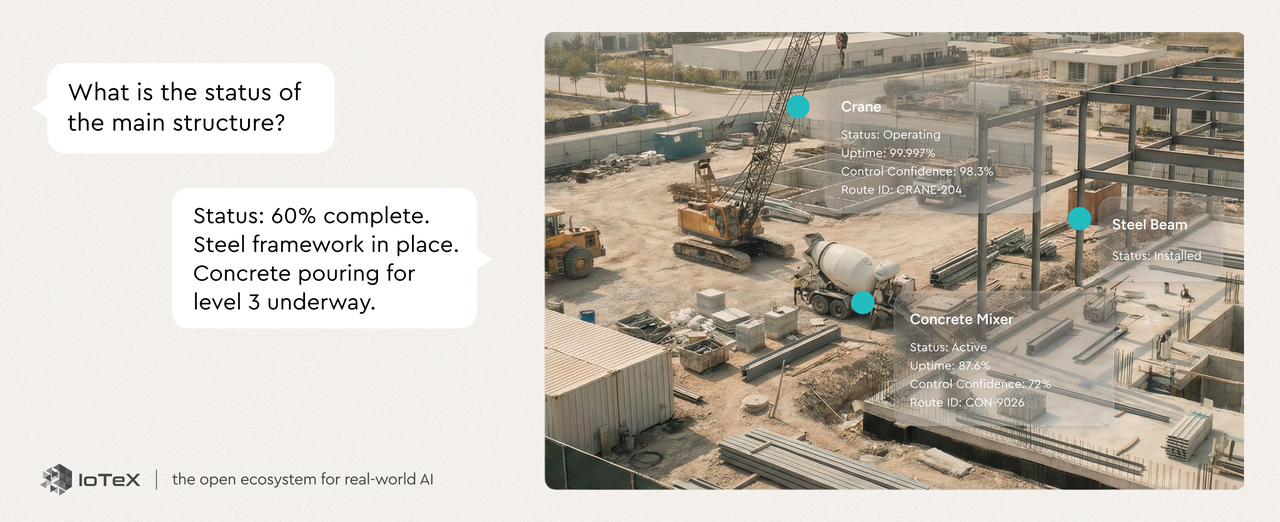
Adoption over narrative. We have hypotheses about where this is valuable — location intelligence, workplace safety, construction monitoring, retail analytics. But hypotheses aren't customers. We measure success by whether someone opens their wallet, not by TVL or partnerships announced. Many small experiments, fast iteration, kill what doesn't work. Product and protocol deliberately decoupled: if a product fails, the chain keeps getting stronger.
Challenge 2: How does IoTeX keep getting more decentralized and unconditionally trustless?
Here's an uncomfortable truth most crypto projects avoid: almost every blockchain would stop evolving if its core team walked away tomorrow. Blocks would keep being produced. But upgrades? Security patches? Adaptation to new threats? Gone. IoTeX is no different today. That's a problem we intend to solve.
In 2025, the network processed nearly 200K daily transactions across 130+ applications, holding at 40% of supply, and institutional validators like Animoca joined the delegate set. But these measure activity, not resilience. The real question is harder: If the core team resigns tomorrow would IoTeX keep running, keep upgrading, and keep getting stronger? We think the answer needs to be yes, and we're working on several fronts:
Trustless bridging through math, not keys. Cross-chain bridges typically rely on multisig wallets — trusted parties holding private keys. Keys can be stolen, coerced, or lost. We're working on replacing this trust assumption with zero-knowledge proofs: a bridge that mathematically proves IoTeX consensus happened correctly, verified on Ethereum, with no trusted intermediaries. We're actively engaging with the Ethereum Foundation on this, particularly in the context of their Native Rollup work which shares technical building blocks with our approach.
AI-operated consensus delegates. Running a delegate node today requires human operators — expensive, scarce, and a centralizing force. What if AI agents could operate nodes at a fraction of the cost? What if one delegate could spawn multiple AI operators, each independently monitoring the chain and responding to incidents? This would break the equation where decentralization = f(token price). If nodes are cheap to run, decentralization stays robust even in bear markets.
A second client implementation. One codebase is a single point of failure. Ethereum learned this with the Geth supermajority problem. We need a protocol specification rigorous enough that an independent team can build a second client from scratch — so that no single piece of software is existential to the network.
Independent security and development structures. A security council that functions without the Foundation. A contributor guild that pays developers directly based on contribution, not employment. Bug bounties funded by the protocol itself.
None of these have neat quarterly deadlines. Some depend on governance votes. Some depend on external developments. That's precisely why a traditional roadmap would be dishonest. What we can commit to is the *direction*: every decision we make should move IoTeX closer to surviving — and thriving — without us.
Challenge 3: How does IoTeX fund itself sustainably, forever?
Most blockchain projects treat "sustainability" as a tokenomics problem — adjust inflation, add a fee burn, hope the math works out. We think that's backwards. The best version of sustainability is the simplest one: build products that make money.
Think about how a successful public company works. It generates revenue, reinvests profits into R&D, and buys back shares to return value to shareholders when cash exceeds needs. Nobody asks Microsoft "what's your inflation schedule?" — the business funds itself. We think a blockchain protocol can work the same way. Not overnight, but as a north star.
In 2025, IoTeX protocol revenue reached $110K in Q3, up 16% QoQ. A start, but not self-sustaining. The question for 2026: can we build products that generate enough revenue to fund protocol development, security, and growth independently?
Product revenue first. If we find product-market fit for physical-world AI, revenue can directly fund core development, security, ecosystem grants — and eventually buy back and burn IOTX, returning value to holders the way a profitable company returns value to shareholders. This is the ideal path and the one we're working hardest toward.
Protocol mechanisms as complements, not crutches. Fee burns, treasury allocations, staking adjustments, inflation — these tools exist and other chains have used them with varying success. They may play a role. But we view them as complements to a real business, not substitutes. A fee burn without genuine transaction volume is theater. A treasury without real revenue is just inflation with extra steps.
Governance matters as much as economics. However the protocol funds itself, who decides how funds are spent matters just as much. Transparent on-chain spending, community oversight, progressive decentralization of control — no single entity, including us, should have unilateral say over the protocol's financial future.
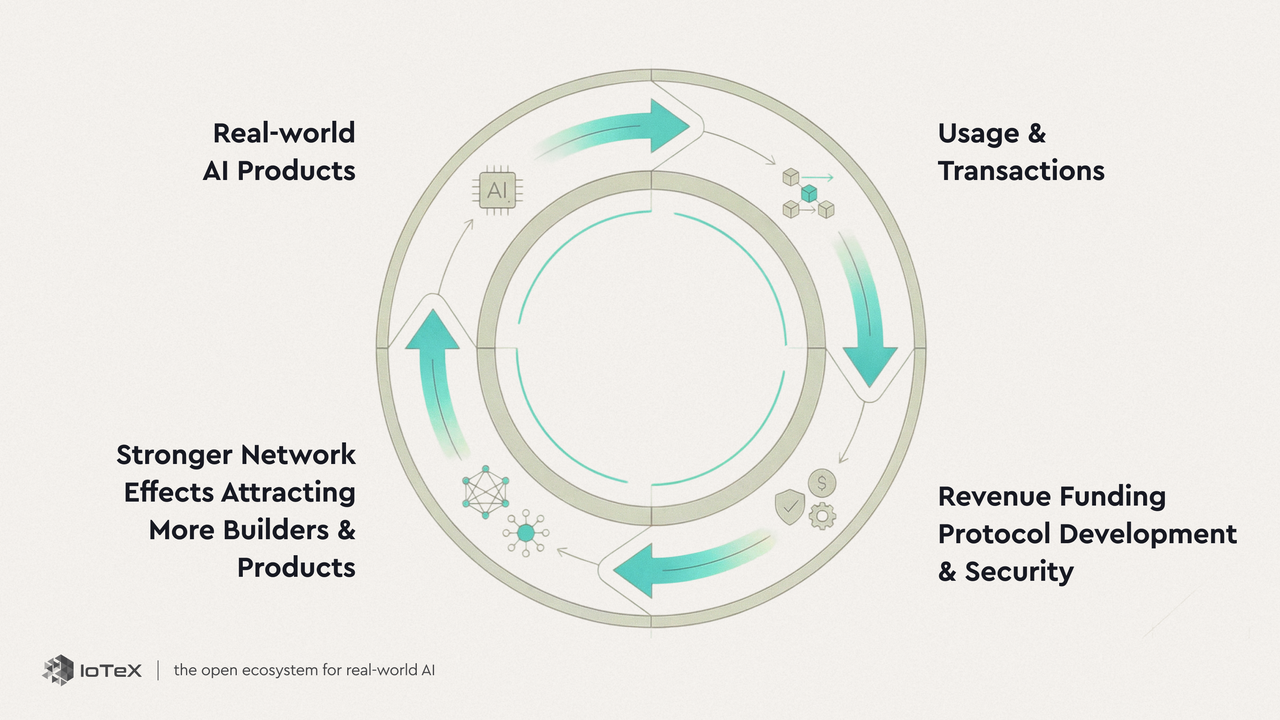
The flywheel we're building toward: products generate revenue and transactions → revenue funds development and buybacks → transactions strengthen the network → a stronger network attracts more builders and products. It doesn't exist today. Building it starts with Challenge 1: making something people pay for.
The current model has a shelf life. We'd rather have this conversation openly than pretend the status quo is fine.
Why an Anti-Roadmap?
This isn't the absence of a roadmap. It's a deliberate argument against them.
2025 proved why. Nobody predicted vision AI would get 100x cheaper, that AI agents would hit production, or that Coinbase would ship a machine payment protocol. Every shift changed what we should build. A rigid roadmap would have told us to keep executing last year's plan while the world moved on.
Roadmaps optimize for predictability — the appearance of control. The winning strategy in an AI-accelerated world is adaptability. Spot opportunities in weeks, not quarters. Kill plans that stopped making sense. Say "we were wrong, here's what we're doing instead."
What we can promise:
- Transparency about what we don't know. We'd rather say "we're searching for product-market fit" than pretend we've found it.
- Speed of iteration. Ship fast, measure honestly, kill what doesn't work.
- Structural resilience. Designed for a world where any single thing can fail — including us — and the system keeps going.
The three challenges — giving AI eyes on the physical world, building infrastructure that outlives its creators, funding itself forever — are compass bearings, not milestones. If these questions interest you, we want to hear from you. Not as spectators, but as builders.
The internet was built for humans. The next version will be built for machines. Machines that perceive the world. Machines that transact. Machines that act. If that future arrives, the infrastructure connecting AI to reality will matter. That is the question IoTeX is trying to answer.
If you don't want to read this article, I used AI to summarize for you. TL;DR version:
Challenge 1: Make IoTeX AI's interface to the physical world
- Vision-first: turn live camera streams into AI-readable intelligence via VQA — no new hardware, 1B+ cameras already deployed, 100x cheaper vision AI
- Expand beyond vision: generalize Quicksilver architecture to all physical-world data
- Revenue as the metric: paying customers over TVL or partnerships; fast experimentation, kill what doesn't work
- Product and protocol deliberately decoupled — if a product fails, the chain keeps getting stronger
Challenge 2: Make IoTeX unconditionally decentralized
- ZK-bridging: replace multisig trust with zero-knowledge proofs; engaging with Ethereum Foundation / Native Rollup work
- AI-operated delegates: break the "decentralization = f(token price)" equation
- Second client implementation: eliminate single-codebase risk
- Independent structures: security council, contributor guild, protocol-funded bounties — all functioning without the Foundation
Challenge 3: Fund IoTeX sustainably, forever
- Product revenue first: fund development, security, grants, and IOTX buyback/burn from real business income
- Protocol mechanisms (fee burns, treasury, staking) as complements, not crutches
- Transparent on-chain spending, community oversight, no unilateral control
- The flywheel: products → revenue & transactions → development & buybacks → stronger network → more builders
Our commitments: Transparency about unknowns. Speed of iteration. Structural resilience — survives any single point of failure, including us.
The IoTeX Team