
Found a Security Issue? There's Now One Private Place to Report It

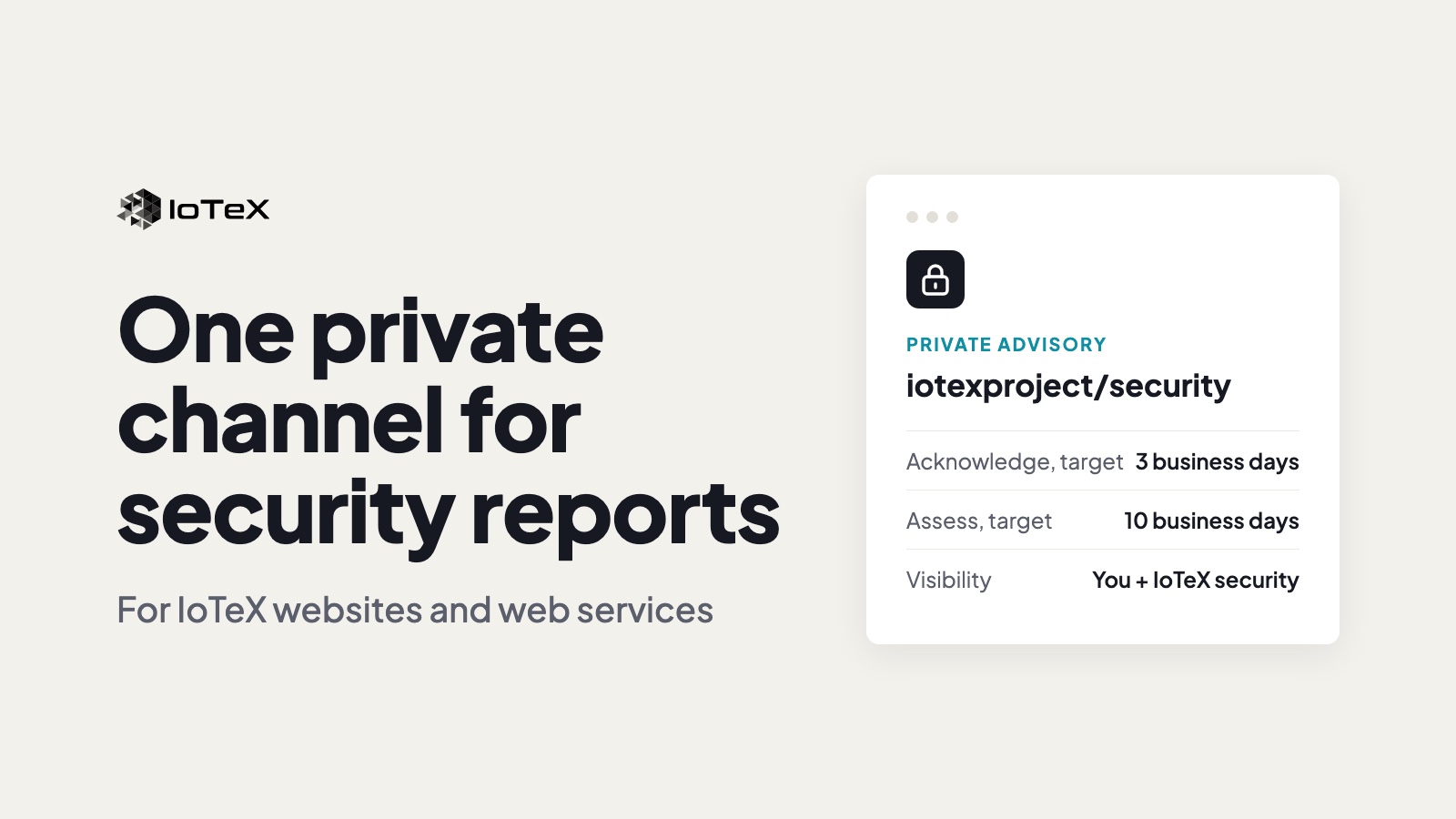
Last week we shipped iotex-core v2.5.2 and thanked the researchers whose reports made it stronger. The node software has had a private reporting channel for a while. Our websites didn’t: a report could arrive by email, a Discord DM or a reply on X, and the reporter had no way to know it reached the right people.
That changes now. IoTeX’s main websites and web services share one private reporting channel, and it is live.
How to report
Open a private advisory on GitHub:
Only you and the IoTeX security team can see it. You can write in English or Chinese. Start the title with the affected service, for example [hub.iotex.io] Stored XSS in profile page.
A good report includes:
- the affected URL, endpoint or feature
- the impact you demonstrated: what an attacker can read, change or do that they shouldn’t be able to
- steps to reproduce, or a proof of concept
- a suggested fix, if you have one
- how you’d like to be credited
Please don’t report vulnerabilities in public GitHub issues, pull requests, Discord, Telegram or X. A public report puts users at risk before a fix exists.
What’s in scope
- 🌐 IoTeX website and docs:
iotex.ioandwww.iotex.io(this blog included), anddocs.iotex.io - 🏛️ IoTeX Hub:
hub.iotex.io, including staking, voting and rewards - 📡 DePINscan:
depinscan.io,www.depinscan.ioand the public API atapi.depinscan.io
More services will be added over time. Not sure whether something is in scope? Report it anyway and say so.
Third-party services we use but don’t run, such as wallets, hosting and RPC providers, should be reported to their vendors.
What we can’t act on: a report that only quotes scanner output or a missing header, with no demonstrated impact. The full policy → lists everything that’s out of scope.
Found an issue in the blockchain itself?
The channel above is for our websites. Vulnerabilities in the IoTeX blockchain go to a separate private channel on the node software’s repository, iotex-core. That covers consensus, staking and rewards, EVM execution, the action pool, P2P networking and block sync, the node’s API, and the ioctl CLI.
It works the same way: a private advisory that only you and the IoTeX team can see. You don’t need a working exploit; a precise root-cause analysis is enough for us to start. The iotex-core security policy has the details.
What happens next
- We aim to acknowledge your report within 3 business days.
- We aim to send an initial assessment, including severity, within 10 business days.
- Confirmed issues are fixed privately. With your agreement, we publish an advisory once the fix is live and credit you in it.
Testing in good faith
For good-faith research that follows the policy, IoTeX will not take legal action based solely on that research.
The rules are short. Use only your own accounts and data. Don’t run denial-of-service tests or high-volume scans. And please keep the details confidential until the issue is fixed and we’ve agreed on disclosure with you.
For automated tools
iotex.io and depinscan.io publish a standard security.txt that points to this channel: iotex.io → · depinscan.io →
Thank you to everyone who has reported issues to us so far. We look forward to working with you.
The IoTeX Team